

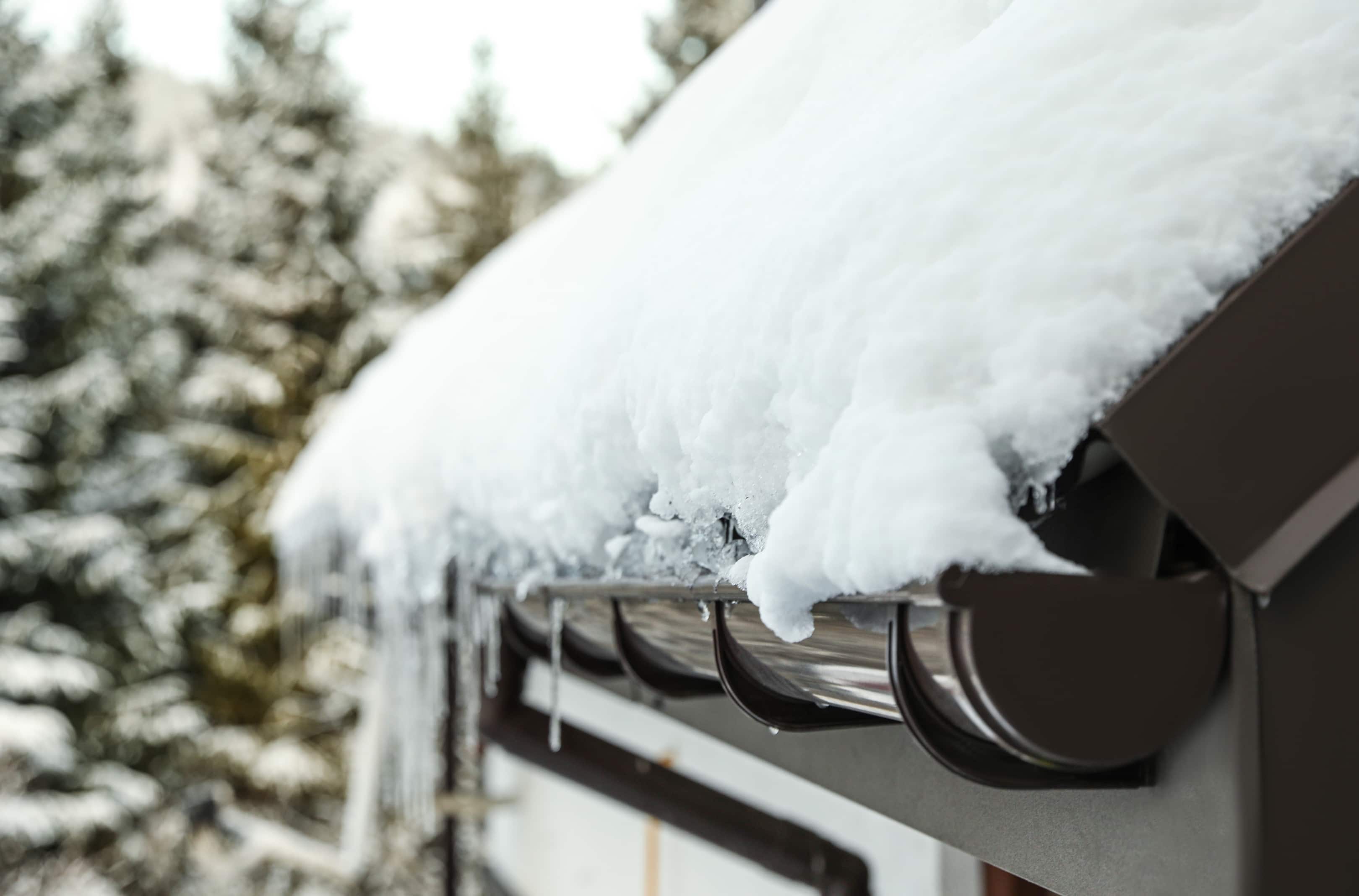
When ice tears a gutter loose, many property owners start shopping for heat cables. Here’s the Gutter Brothers’ honest take on what keeps gutters flowing through a Four States winter.
What Are Heated Gutters, and How Do They Work?
These systems use electric gutter heating cables, often sold as heat tape for gutters, to melt a drainage path through snow and ice. A National Research Council of Canada building digest describes cables rated at 5 to 7 watts per foot, laid in a zigzag along the eaves with points about 2 feet apart, plus a run through the gutter and down the downspout. It also cautions that cables may not clear large ice dams once they’ve formed.
Why Do Gutters Ice Up in the Four States?
Most gutter ice starts on the roof. University of Missouri Extension explains that ice dams form when roof temperatures are uneven, as warm air leaking into the attic melts snow that refreezes at the colder eaves. Gutters freezing in winter usually trace back to one of five problems:
- Attic heat loss that melts rooftop snow
- Leaves and debris that hold water in the gutter
- Too little pitch, so water sits
- Undersized or clogged downspouts that back up
- Loose hangers that let ice-heavy gutters sag
Can Leaf Guards Prevent Gutter Ice?
Leaf guards can’t stop ice dams, but they eliminate a major cause of gutter ice: Clogs that trap standing water. UMass Amherst building researchers note that gutters don’t cause ice dams, but they concentrate ice at the eaves, and ice-filled gutters often bend and rip away from the house. MU Extension engineers recommend a slope of 1/16 inch per foot and hangers every 1.5 feet where ice and snow linger. As for how to prevent ice dams at the source, MU Extension advises sealing attic air leaks and raising ceiling insulation to R-38 to R-49.
How Much Does It Cost to Run Heated Gutters?
Take 100 feet of cable at the digest’s low end of 5 watts per foot: It draws 500 watts, or 12 kilowatt-hours a day running nonstop. At Kansas’ September 2026 average residential rate of 15.83 cents per kilowatt-hour, reported by the U.S. Energy Information Administration, that’s about $1.90 a day, or roughly $57 a month. The digest advises shutting cables off above 45 degrees. The UMass researchers also warn that heat tape can make shingles brittle and create a fire risk.
When Do Heated Gutters Actually Make Sense?
Cables earn their keep on trouble spots that ice up every year despite clean, well-pitched gutters, such as north-facing eaves and roof valleys where snow lingers. The UMass researcher put it bluntly: “In my entire life, I have never seen a zig-zag arrangement of electrically-heated cable work to fix an ice dam problem.” For most homes and businesses, heated gutters should come after the basics, not before.
Find out why your gutters freeze before the next ice storm. Call Clear Cut Gutters at (620) 762-3449 to schedule an on-site visit. The Gutter Brothers will quote gutter cleaning and leaf guard installation, check pitch and hangers, and size the right gutter and downspouts for your home or business, so meltwater drains instead of freezing.